
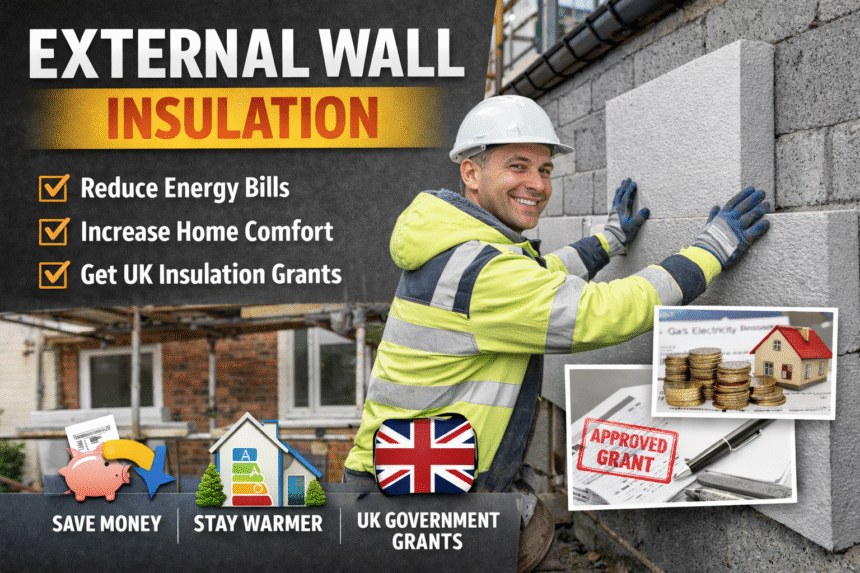
External Wall Insulation: Costs, Benefits & UK Grants (2026 Complete Guide)
External Wall Insulation (EWI) can transform comfort and efficiency in older UK homes — but it’s also a major retrofit measure where correct design, ventilation checks and installer competence really matter.
What is External Wall Insulation?
External Wall Insulation (EWI) is a system where insulation boards are fixed to the outside of a property and then covered with a protective base coat, reinforcing mesh and a durable finish (often a coloured render). The result is a continuous thermal “jacket” around the home that reduces heat loss and improves comfort.
It’s especially common on solid wall homes (often built before the 1920s) that do not have cavity walls. Solid walls lose more heat than cavity walls, and insulating them externally or internally is a key way to reduce that loss. (See: Planning Portal guidance)
Typical EWI build-up (simple version)
- Insulation boards (EPS / mineral wool / phenolic etc.)
- Mechanical fixings (plus adhesive, depending on system)
- Base coat + reinforcing mesh
- Primer (system-specific)
- Finish coat (silicone / mineral / acrylic render, brick slips, cladding, etc.)
Why the finish matters
The finish isn’t just cosmetic — it protects the insulation from weather, impacts and UV exposure. Choosing the right render type for your location (coastal, shaded, high rainfall) can make a big difference to longevity.
Who is EWI best for in the UK?
EWI is usually a strong option if you have:
- Solid walls (common in older terraces, cottages, and some 1930s builds).
- Uninsulated or poorly insulated walls causing cold rooms, high heating bills, or damp-related issues (after diagnosis).
- A property where you can legally/visually change the exterior (check planning, conservation areas, and party wall considerations).
Benefits of External Wall Insulation
Lower energy bills
Insulating solid walls can significantly reduce heat loss. The Energy Saving Trust explains that insulating solid walls can help you save energy and cut heating costs (exact savings depend on house type, fuel, and how much you heat your home). (Energy Saving Trust)
Improved comfort
EWI helps keep indoor temperatures more consistent and reduces cold-wall “chill”. Many homeowners notice fewer draughty rooms, warmer bedrooms and more stable temperatures throughout the day.
Reduced carbon emissions
Using less energy for heating reduces your household emissions. It also supports future upgrades like heat pumps, which perform best in well-insulated homes.
Enhanced kerb appeal
Fresh render or cladding can modernise tired façades, hide patchy brickwork, and visually “lift” older properties. Many systems offer a wide range of colours and textures.
Weather protection
A good EWI finish adds a protective layer against wind-driven rain and helps manage moisture when designed correctly (including detailing, sealants, and movement joints).
Condensation & damp: a real-world note
EWI can reduce condensation risk by warming internal wall surfaces — but moisture problems can also be made worse if ventilation is ignored or detailing is poor. That’s why modern retrofit standards focus heavily on assessment and ventilation.
External Wall Insulation cost in the UK
Most homeowners want a straight answer on price, but EWI costs vary because scaffolding, detailing and finish choices can change the job dramatically.
As a broad guide, many installers quote somewhere around £90–£140 per m² for standard EWI packages, depending on access, finish type and complexity.
| Property type (example) | Typical project range | Why it varies |
|---|---|---|
| Small terrace / end-terrace | Often £7,000–£13,000 | Wall area, rear access, scaffold configuration, amount of detailing around openings |
| Standard semi-detached | Commonly £8,000–£15,000+ (sometimes higher) | Two elevations vs three, bay windows, soffits, pipes, finish choice, scaffold height |
| Detached / complex façades | Often £15,000–£30,000+ | Large wall area, multiple elevations, complex architecture, higher scaffolding |
These are guidance figures, not quotes. Always get a survey and a written specification (including thickness, system brand, details, and warranty terms) before comparing prices.
Factors affecting installation cost
1) Property size & wall area
Cost scales with the surface area to be insulated — but not perfectly linearly. Small jobs can have higher “base” costs because scaffolding and set-up are still required.
2) Scaffolding & access
Narrow access, conservatories, extensions, or public footpaths can increase scaffold design complexity and cost.
3) Render type & finish
Silicone renders often cost more than basic mineral or acrylic options, but can offer better water repellence and colour stability (system dependent). Brick slips and premium textures typically increase labour and material costs.
4) Detailing (openings & features)
Bay windows, ornate features, deep reveals, sills, and lots of pipework mean more cutting, profiling, beads and time.
5) Substrate repairs
EWI needs a sound background. Loose render, crumbling brickwork or damp defects must be addressed first.
6) Guarantees & compliance
Proper design, retrofit assessment, ventilation checks and paperwork are part of doing the job correctly — and they’re worth it.
Government grants for External Wall Insulation (2026)
1) ECO4 (Energy Company Obligation)
ECO4 is an obligation on larger energy suppliers to deliver energy efficiency measures to eligible households. In January 2026, the UK Government confirmed ECO4 has been extended so it now ends on 31 December 2026. (Official government response)
ECO4 projects follow a “whole-house” retrofit approach and typically require processes aligned to PAS 2035, including proper assessment and design. (Ofgem ECO: supply chain)
2) Great British Insulation Scheme (GBIS) – status in 2026
GBIS was a government-backed scheme designed to help households access free or cheaper insulation. The scheme is scheduled to run until 31 March 2026. (GBIS summary (GOV.UK))
Note: the GOV.UK eligibility checking service has closed, although some energy suppliers may still accept applications directly. (GOV.UK GBIS page)
3) What’s next: the Warm Homes Plan (new programmes)
In January 2026, the Department for Energy Security and Net Zero published the Warm Homes Plan, setting out how the government intends to upgrade homes and cut bills, including funding routes that local authorities and social housing providers may use. (Warm Homes Plan (GOV.UK))
If you’re not eligible under ECO4/GBIS, keep an eye on local authority programmes and regional schemes that may open under new funding.
4) Devolved nation support (Wales/Scotland/NI)
Support differs by nation. For example, Wales has the Nest Warm Homes Programme within the Warm Homes Programme framework. (Official campaign guidance)
Is External Wall Insulation worth it?
For many solid-wall homes, EWI is one of the most meaningful upgrades you can make — especially if you plan to stay long-term. The value tends to come from a mix of:
- Lower running costs (less heat lost through walls)
- Improved EPC rating (often beneficial for resale and compliance)
- Better comfort (warmer walls, fewer cold spots)
- Exterior refresh (façade looks newer, more consistent)






No comments yet